THE
COVENANT.
An Extra Virgin Olive Oil. From the Messara Valley, Crete.
Most olive oil is harvested ripe. Our required production standard demands Koroneiki and Tsounati olives picked at 15-20% ripeness, the peak polyphenol window. What results is not a condiment. It is olive oil at its most alive, from a grove of 250+ year-old trees.
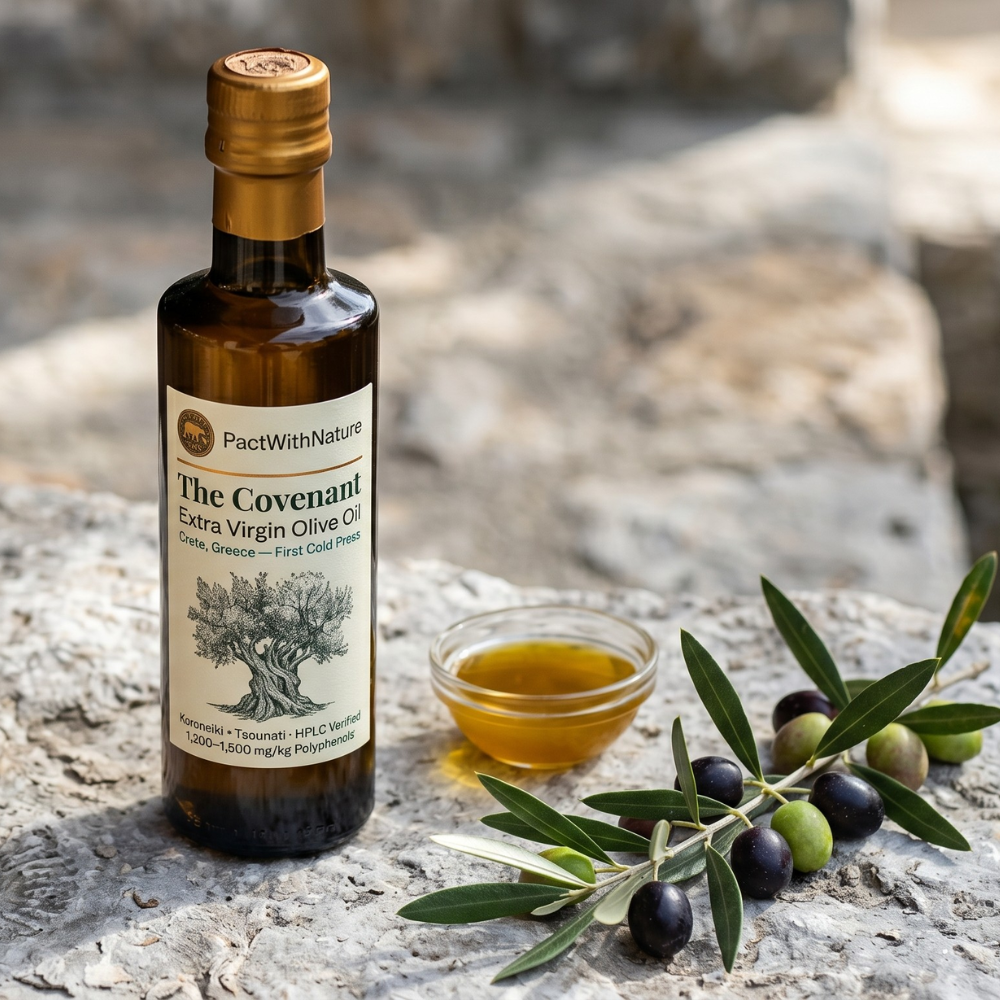
Miron Violet Glass
Blocks UV · Preserves polyphenols
Soft-touch matte label · Hand-applied wax seal
🐻 $1/bottle → Sun Bear Conservation
The Source
From the Messara Valley, Crete.
Where the White Mountains meet the oldest olive groves in Europe, our sourcing standard targets a multi-generational family grove that presses oil the traditional way. We are verifying our grove partner now.
Our Messara Valley Sourcing Standard.
Our standard requires harvest to begin in early October, when Koroneiki olives are 15-20% ripe. Every other producer in the valley waits until November, when the olives are plump, dark, and easy. By then, polyphenols have dropped by 60-74%. We will not accept that compromise.
Olives must be picked by hand with no machinery to bruise the fruit, reach the press within 4 hours, be cold-extracted below 27°C, malaxed under 20 minutes, and nitrogen-flushed immediately after extraction. No bottle ships without documentation confirming each step. We are verifying the grove partner that meets this standard; your bottle will arrive with their verified name, GPS coordinates, and the batch-specific HPLC-IOC lab report.
The 4-Hour Rule
Target Region
Messara Valley, Heraklion Prefecture, Crete, Greece · verified grove GPS ships with every bottle
Grove Age (required)
Trees must show documented age of 250+ years; root system history traced to pre-industrial cultivation
Varietals (required)
80-90% Koroneiki (highest oleocanthal density in Greece) + 10-20% Tsounati (rare, near-extinct Cretan cultivar)
Harvest Window (required)
Early October · 15-20% olive ripeness index · Maximum polyphenol moment
Mill to Bottle (required)
4-hour harvest-to-press rule · Cold extraction · Nitrogen flush · Batch COA published per bottle at launch
Lab Standard
HPLC-IOC method · the only IOC-certified legally defensible standard · actual batch values published at launch
What Is In The Bottle
What Makes This Oil Different.
How it is grown, pressed and protected, and how you can check it yourself.
The Peppery Catch
The sting at the back of your throat is oleocanthal. It is how you know the oil is fresh.
Oleocanthal is a natural compound in fresh, early-harvest olive oil. Researchers at the Monell Chemical Senses Center identified it as the source of the peppery sensation felt in the throat. It fades as oil ages or meets light and air, so the catch is a sign of freshness you can check yourself, without a lab.
Beauchamp et al. · Nature 2005 · Monell Chemical Senses Center
Picked Early, On Purpose
Harvested green, at 15-20% ripeness, when polyphenols are at their peak.
Polyphenol levels in olives fall as the fruit ripens. Our standard requires harvest in early October, weeks before most of the valley picks. That means less oil from every tree, and more of what makes an olive oil taste alive.
PactWithNature sourcing standard · Messara Valley, Crete
Four Hours to the Press
Oxidation begins the moment an olive is picked. Ours must reach the mill within four hours.
Our standard requires hand harvest with no machinery to bruise the fruit, pressing within 4 hours, cold extraction below 27°C and malaxation under 20 minutes. No bottle ships without documentation confirming each step.
PactWithNature sourcing standard · the 4-Hour Rule
Kept From Light and Air
Nitrogen-flushed and sealed in violet glass, because light and oxygen are what age an oil.
Immediately after extraction the oil is moved into nitrogen-flushed containers, and each bottle is flushed again before sealing. Miron violet glass blocks visible light. What was in the oil at the mill is what reaches your table.
PactWithNature packaging standard
Measured, Not Claimed
Every batch is tested by HPLC, the method recognised by the International Olive Council.
Each bottle carries a batch number that links to its full Certificate of Analysis: total polyphenols, free acidity, peroxide value, harvest date and mill date. The numbers on this page are our required minimums. The numbers for your bottle are published with its batch.
HPLC method · International Olive Council
The EU Polyphenol Claim
Our target sits well above the level EU law requires for its olive oil polyphenol claim.
EU Regulation 432/2012 permits the claim 'olive oil polyphenols contribute to the protection of blood lipids from oxidative stress' for oils containing at least 5mg of hydroxytyrosol and its derivatives per 20g. The Covenant's required minimum of 1,200 mg/kg total polyphenols equates to about 24mg per 20g serving. The actual value for each batch is published with its lab report.
EU Regulation 432/2012 · European Food Safety Authority
Batch Transparency
Every Batch. Every Number. No Secrets.
Every bottle carries a batch number that links to its full Certificate of Analysis, published online and always available.
Certificate of Analysis, per batch
Every batch will publish full HPLC results, peroxide values, free acidity, harvest date, and mill date, tested by the HPLC-IOC method, the only IOC-certified, legally defensible standard. Each candidate grove must prove these minimums before a single bottle is produced.
Scan per batch
pactwithnature.app/covenant/batch-[XXX]
The Container
The Most Intentional Bottle on Your Counter.
Packaging is not decoration. It is preservation. Every material choice here has a reason and a science behind it.
Miron Violet Glass
Standard dark glass blocks visible light, but UV light still passes through and degrades polyphenols. Miron violet glass (Swiss-origin, biophotonic) blocks the entire visible spectrum including UV while allowing beneficial near-infrared radiation through. In documented studies, organic substances in Miron glass showed significantly lower degradation versus amber glass at identical conditions. For oil where every mg/kg counts, this is not a luxury. It is the best preservation technology in bottle format.
Hand-Applied Wax Seal
The neck of every bottle is sealed with a hand-applied Forest Deep green wax seal, stamped with the PactWithNature leaf mark. The wax is applied at the cooperage, not by machine. This is a signal: someone touched this bottle with intention before it reached you. That is unreasonable hospitality made physical. The seal also functions as a tamper indicator: if the seal is broken, the bottle has been opened.
Nitrogen Flush + One-Way Valve
Immediately after extraction, the oil is transferred into nitrogen-flushed containers. Oxygen is the primary enemy of polyphenols: oxidation begins the moment oil contacts air. The bottle is nitrogen-flushed before sealing. The soft-touch matte label carries UV spot varnish on THE COVENANT wordmark, creating a subtle tactile difference you feel when you run your finger across the label. These details are not random.
Synergy
The Daily Pact.
THE COVENANT EVOO + THE ORIGIN Supplement = one morning ritual you can read from top to bottom.
THE COVENANT
Early-harvest oil from Crete. The peppery catch of oleocanthal. A lab report for every batch.
$54/mo
THE ORIGIN
34 whole-food ingredients. 8B CFU probiotics. Prebiotic inulin. KSM-66 Ashwagandha. Ceremonial matcha.
$69/mo
The Problem
The Olive Oil Fraud Problem.
Olive oil is one of the most often mislabelled foods. In a 2010 UC Davis study, 69% of the imported oils sampled that were labelled "extra virgin" failed the extra virgin standard.
Polyphenol numbers depend on the test used. We publish HPLC results, the method recognised by the International Olive Council, so our numbers can be compared like for like.
Our Answer
Documented Traceability.
Pre-Order Now
Choose Your Format.
One annual harvest. Limited allocation. Ships within 4 weeks of pressing, guaranteed fresh.
500ml Miron glass · Monthly · Cancel anytime · Ships within 4 weeks of harvest